
Speak Dutch, Open Doors: Why Learning the Language Changes Everything
Categories: Education,Latest News
We often talk about learning Dutch from the perspective of the new arrivals. Expats fresh off the plane/train/automobile, who are looking to hit the ground running in their new home. But the truth is that isn’t always necessary.
In the major cities, many offices are multi-national. There, English often becomes a default. Meanwhile outside of work, there are expat clubs relating to every interest or pastime you can think of. We have featured many of them in the Lifestyle segment of Expat Republic!
That’s all great, because you can feel welcome as soon as you arrive in the Netherlands. But it can also mean that the longer you settle here, the harder it is to stay motivated. Your DuoLingo streak crashes. Your old copy of Dutch for Dummies gathers dust. Hypothetically, the person writing this might have gone through the Dutch naturalization process, only to slack on their lessons the moment their passport arrived…
The thing is, while we absolutely can get by just fine with just the basics, there are still some reasons why fluent Dutch could be a real boon. Professionally, educationally, and conversationally. Let’s take a look at some of the opportunities which going Dutch might open up for us!

The Working Angle
It would be wrong to say you can’t make a good living in the Netherlands, without picking up the language.
As non-native English speakers, the Dutch are the undisputed World Champions. For close to a decade, the Netherlands has topped the EF English Proficiency Index. And as internationals are in hot demand across the economy, jobs of every shape and size are open to English-speaking expats.
At the same time, self-employed ZZP’ers account for about 12% of the workforce. So, if you feel like the office life isn’t for you, contracting in English is also a viable alternative.
But the point is not that you must. It’s more that by learning Dutch, you open doors that could lead to places you never even knew you wanted to go.
Many of us reach a point in our careers where we realize it’s time for a change. We may choose to shift across functions, companies, or even industries. And the reasons for that are not only monetary; that is also driven by a quest for greater fulfilment. The need to find purpose in what we do. And if that sounds like you, learning Dutch could widen your options no end! There are so many jobs – especially client-facing roles – where English is not enough.
For example, imagine you wanted to move into healthcare. If you want to work as a nurse in the Netherlands, you will need to be fluent in Dutch – at B2 level. After all, you must be able to communicate with your patients and their relatives. Not to mention your colleagues, or other healthcare professionals.
At the same time, if you are a ZZP’er, the end of each contract may feel less stressful – because you have opened up new possibilities. Drumming up new business, especially in a line of work which is becoming tightly contested, can be a worry. But knowing you can play to your strengths in at least two languages will widen the field, and take some of that pressure off.
For example, if you’re a copywriter, you know the experience all too-well. Log on to LinkedIn. Browse the ‘Jobs’ section. Despair as 90% of the independent work requires Nederlands. Think what that would feel like if Dutch were no longer a barrier, though! Suddenly, the churn of chasing new contracts seems a whole lot less daunting!
Beyond the practical requirements of job-seeking, there are other benefits to Dutch proficiency. Breakroom conversation is a much more liberating experience all of a sudden. While your colleagues will likely include you in English chat, and you will strike up friendships, no problem. But eventually they may shift back to Dutch. And rather than being left behind – or nodding with an embarrassed grin to disguise your confusion – you can still participate. Gezellig.
At the same time, even in an English-speaking role, learning Dutch can signal commitment to employers. That opens some serious doors. If you want to grow in a company, showing initiative, and connecting with other team members really boosts promotion chances.
After all, imagine you were the boss. You’re interviewing for a management position. You have two people with the same levels of experience. They are both excelling in their current role. But one speaks two languages, and the other only speaks English. Who are you picking? Spoiler: it’s the one who can welcome new hires, and can train and advise them in whichever language they are most comfortable in.
The Studying Angle
As an expat taking up studies in the Netherlands, you face a series of hurdles. But while accommodation, transport and insurance can be tricky, language is less trouble. After all, most top universities here offer courses in English and Dutch.
Even so, for some situations, having a grounding in Dutch has real practical value here. For example, you might be a history student, learning about the 1600s. You might stumble upon a primary source about de pest that could add a great new dimension to your Gouden Eeuw essay. But it’s written in Dutch. Having a grounding in the language yourself takes on a major benefit then. The cultural and contextual clues contained in modern Dutch could even help you find extra insights in the text.
And while English remains an option for Dutch universities at the moment, it is not guaranteed to stay that way. In 2024, the government announced plans to restrict English-taught degrees. While a change in government led to that plan being scrapped in 2025, new programs will still face stricter requirements. In practice, this may not be a ‘ban’, then, but may still lead to a phasing out. With this uncertainty, international bachelor enrolment in the Netherlands fell by 5.2% in 2024-25 – the first such decline in nearly a decade. Being able to speak Dutch does somewhat remove you from that uncertainty, though.

The Living Angle
Finally, of course, speaking Dutch opens doors when it comes to your quality of life. As already touched upon, it is possible to speak with Dutch people – and make good friends – in English. But Dutch does make it easier – especially when you can follow a joke between languages. There are few things quite as alienating as missing the punchline, and shared humor is a key form of currency in any new relationship.
At the same time, you can sometimes see an entirely new side to someone. Whether you subscribe to linguistic relativity (the idea the structure of a language can shape the way we perceive the world), or not, speaking your native tongue changes how you interact with people. When you speak a language from childhood, you grow with it. It feels instinctive and comfortable – and that’s when you can have most fun with a conversation.
You experience this from another language – but it is the same for Dutch people. Giving them the chance to feel that way when speaking to you, goes a long way. It’s worth it, even if, for a change, it means you are less comfortable, having to think about what you say.
In many other aspects of life, there are big plusses, too. Speaking at the market, in the street, at the bar, changes how people may respond. Even basic Dutch can see people become warmer, and more inclusive. A frustrating appointment with the gemeente, or huisarts might become a much simpler affair. Understanding the market trader’s preference for cash over card might land you a discount!
And then there is the importance of understanding what is happening around you, quickly. In our social bubbles, we take for granted someone will be there to explain something if we are confused. In the event of an emergency, plumbing something into Google Translate is not a good idea. So being able to read emergency alerts – or ask others what is going on if your phone is out of charge – could be crucial.
On top of all this, there may also be a health benefit to boot. While many of us chase different apps, games or tricks for ‘brain training’, learning Dutch is a real hack to boosting your little gray cells!
Studies suggest that people who are multilingual are half as likely to show signs of accelerated biological ageing. This includes papers saying the average bilingual adult may receive a dementia diagnosis 4–5 years later than a monolingual individual. That might be the most important opportunity of all the ones we’ve mentioned.

The Solution
Learning a new language is paradoxically easier said than done. The practicalities of the busy international life mean we don’t always have much time. Many expats are already juggling hectic jobs with family life, on top of dealing with the admin related to moving to a new country. But we have some good news for you.
You don’t need an expensive school. And you don’t need to move your life around. Self-study is an option open to everyone. You can work at your own pace; with special structure and support.
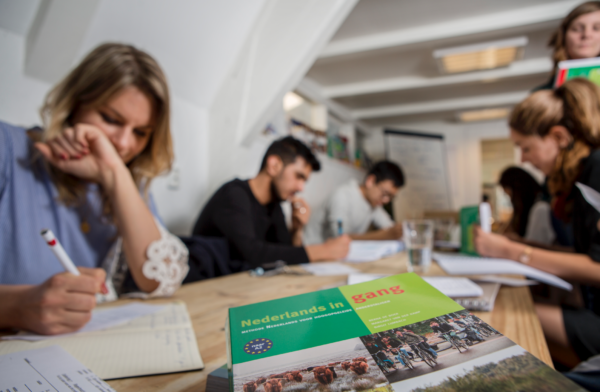
One provider of such a learning experience is Boom NT2. The publisher of Dutch-as-a-second-language (NT2) learning methods offers a complete self-study package. This includes a book, an online platform at nt2school.nl, and four sessions with an NT2 teacher. You are also connected to a volunteer language buddy for conversation practice – and exam prep. That’s really useful if you’re putting this toward the Inburgering and Staatsexamen NT2.
Boom NT2’s self-study package is available from absolute beginner (0–A2), up through B1 and B2. So, whether you are brand new to the Netherlands, or have already made a home here, there is support for everyone! And while starting is the hardest part of any journey, building a habit means soon you’ll notice the difference. At the office, the dinner table, the bar, or the supermarket. It’s the difference between living in the Netherlands, and being part of it.