
The Best Apps to Help You Learn Dutch
Categories: Education
When it comes to planning a future in a new country, language remains one of the key barriers. That’s why the Netherlands is often considered the best destination for English-speaking expats. The nation’s proficiency for English is often cited as one of the reasons Amsterdam is the top hub for internationals in Europe, for example. Even then, though, sooner or later, we all have to face an interaction where we can’t rely on this. Important legal documents will be in Dutch. Live television usually only comes with Dutch subtitles. Even in a group of friends, we expats can fluctuate between feeling guilty for making everyone speak their second language. Or feeling excluded when people instinctively lapse back into their native tongue.
That means that we can’t dodge the minefield of Dutch grammar – the d/t dilemma, the het/de equation, and so much more – forever. When it comes down to taking that leap and learning Dutch, however, it’s easier said than done – if you’ll excuse the pun. There are some excellent courses and language-hacking expertise available. But the busy expat’s schedule doesn’t always come with bags of spare time. As such, most of us will turn to a language learning app for help.
Like everything else in life, though, not every app is appropriate for every user. Depending on what you are looking for and what you can commit to, some will work better or worse. And finding out which is best for you can be a challenge in itself. One which can see your motivation decline if misjudged. As always, Expat Republic is here to help. To explore your options, we’ve weighed the pros and cons of the Big Four: Duolingo; Busuu; Babbel; and Dutch-Online.
Duolingo
The most famous of the quartet by some distance is Duolingo. Thanks to its viral marketing strategy, including a notoriously flirty/sassy/threatening cartoon owl, the platform has become a cultural phenomenon in its own right. But what kind of actual results does it deliver?
Pros
- An extensive offering of more than 40 languages. Everything from Spanish to Klingon.
- A gamified experience using fun to build learning habits. Points, streaks and leaderboards motivate you to stay consistent.
- An online interface means you can enjoy the same experience on a desktop or a smartphone.
- Duolingo is free to use for as long as you like.
- Bonus premium content is available. If you’d like to upgrade, to make the most of AI phone conversations, among other tests of your Dutch, individual subscriptions are from €13.99 to €16.99 per month.
Cons
- The most popular languages receive the most attention from developers. Dutch is not in the top 10 languages on Duolingo.
- There is a limited set of tasks for ‘Dutch’ learners. Content in the language only comes with two voice actors. And there are no ‘games’ that other languages enjoy.
- A lack of structure and explanation means conversational Dutch is a distant prospect. While you get the building blocks of the language, you miss out on the cement of the grammar and practical usage.

Babbel
After Duolingo, Babbel is likely to be the other language learning app you’ve heard most about. The platform offers a less flashy, but arguably more mature option to learners. This is demonstrated by its 13 languages offered – which include Spanish, French and Dutch, but not Klingon.
Pros
- A more structured approach to learning can yield more important progress. This can feel more grown-up for anyone beyond a beginner level.
- Sessions balance speaking practice and vocabulary building, with grammatical and structural explanations.
- Lessons hinge on practical outcomes, with its Dutch mode providing support to move from beginner (A1) to intermediate (A2) levels.
- There are free trials of every course for users keen to try before they buy.
Cons
- There is no free tier for long-term use. While pricing between approximately €6.99 to €17.95 per month might seem affordable, if you are looking for an experience without a bill, this isn’t for you.
- Similar to Duolingo, Babbel developers tend to focus on the most popular languages. Paying for an experience that you might feel is ‘less-than’, compared to a course in another language, is not ideal.
- Babbel does not ask you to produce your own phrases or sentences in a foreign language. And it has no equivalent of a human interaction – simulated or real – so it remains best as a supplement, rather than the main mode of your Dutch lessons.
Busuu
Busuu is a widely popular language-learning app, best known for its community-based approach. Available through the app store, or in browser, alongside Babbel it is one of the oldest of the modern language platforms. It launched in 2008, which means its approach to communal learning has amassed a vast library of insights.
Pros
- Community-based feedback challenges other models, in terms of the amount of context and content for even ‘less popular’ languages.
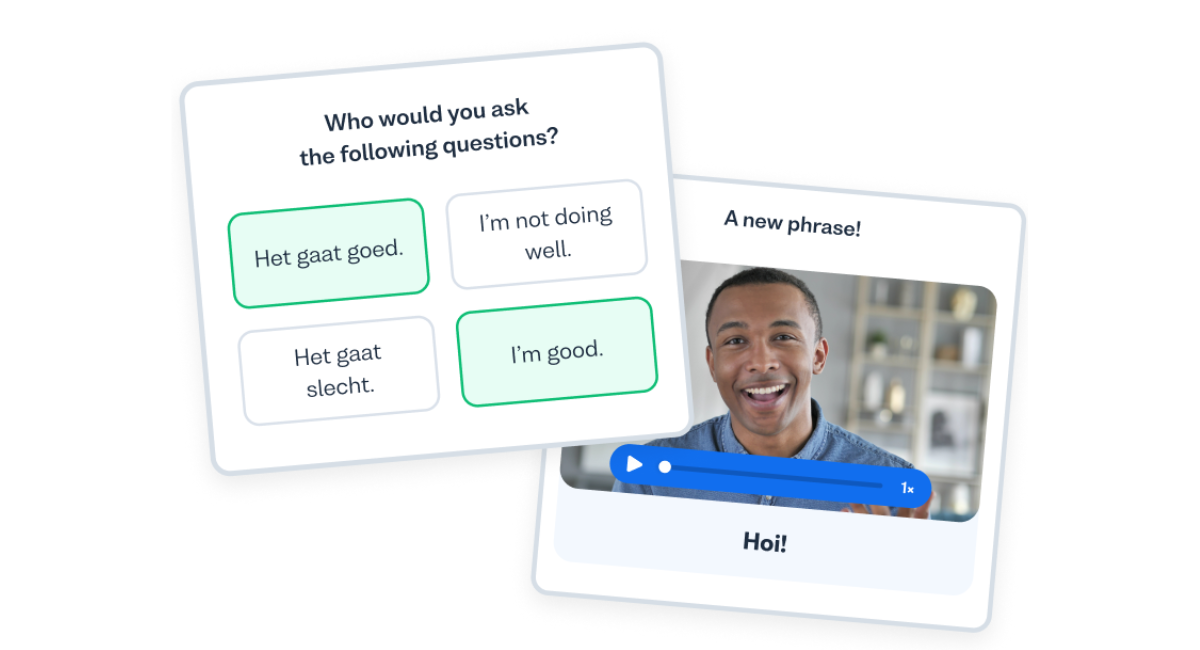
- Despite only 16,000 of Busuu’s 120 users learning Dutch, videos of native speakers in lessons, and annotated corrections from other users mean you get a deeper experience of language as a communicative tool.
- Busuu presents a hybrid between structure and fun. Users get three daily challenges to pass, and can obtain stars (like XP points) to gamify the experience. Meanwhile, you will also find useful grammar instructions layered into lessons.
- Free continuous access is available. But subscriptions to premium content start at €9.99 per month for short-term plans. It matches Duolingo’s offer of budget learning, then, but also offers a more affordable ‘pro’ version.
Cons
- Again, the free version is more limited than the premium content. Full lessons with detailed corrections – the biggest draw of the app – require a subscription.
- Time is money. Automated software can provide instantaneous ratings of your input, but community feedback takes time. And if you are paying for the service, waiting on this is a big drawback.
- Too many cooks can spoil a broth. There are downsides to the community aspect of learning this way. Two sources can contradict each other. If you are looking for a consistent experience, this can be a drawback.

Dutch-Online
To many expats, those three apps are already household names. Get ready to add another.
Dutch-Online is an e-learning platform and mobile app, designed for expats, offering self-paced courses. Most importantly, it is produced by native speakers, and unlike the other options discussed, it focuses exclusively on Dutch. The CEFR-aligned Dutch courses from level A1 to B1 offer an unparalleled level of rapid, consistent feedback.
- The app – also accessible via a browser – contains more than 8,000 exercises, 8,200 audio files, and vocabulary training.
- If you are looking for a way to learn conversational Dutch, you can’t avoid regular speaking. Digital exercises, covering reading, writing, and listening, are followed by live speaking classes and personalized feedback.
- One of its strongest features is the use of AI to give instant feedback on speaking and writing. You can submit answers and receive corrections alongside model answers, helping you understand not just what is wrong, but how to improve.
- The platform now also includes a full inburgering A2 preparation module. This covers all exam components, including speaking, writing, listening, reading, and KNM (Kennis van de Nederlandse Maatschappij).
- Emphasizing speech in a daily context, lessons end with an AI-conversation session. But where Dutch-Online really comes into its own is what happens next. Weekly speaking classes, scheduled a month ahead, give you the chance to discuss lessons with other learners.
- A human teacher is also a huge plus. Speaking to an expert can give you a tailored, authoritative, and consistent view on how to enhance your experience.
- Join when you are ready. Classes are not compulsory – you can join when you have time, or when you feel comfortable. In the interim, you can also access a WhatsApp helpline for instant support learning.
- Dutch-Online charges €25 per month for its service. And if you would like to get a taste of what you get for that, it offers a free seven-day trial. That provides full access to the platform, with lessons, exercises and smart practice available for levels of A1 and A2.
Best in Show
Again, different learners respond best to different forms of learning. Duolingo remains the best option for those looking for a free, gamified experience. Babbel is best for short-sentence production and grammatical basics. And Busuu tops the list for community feedback. But for anyone looking to systematically move to the A2 or B1 levels of Dutch, Dutch-Online is the way to go.