
Choosing a Basisschool in the Netherlands: A Guide for Expat Parents
Categories: Education,Latest News
Choosing a basisschool in the Netherlands can feel overwhelming, especially for expat parents trying to understand the Dutch education system. From public and religious schools to Montessori, bilingual, and international options, parents need to weigh location, teaching style, costs, and language before making a decision. This guide explains how to choose a basisschool in the Netherlands, when children start school, how registration works, and what to expect from different school types.
In this guide
- Basisschool Options in the Netherlands at a Glance
- When Do Children Start Primary School in the Netherlands?
- What Types of Basisscholen Can You Choose From?
- How School Registration Works in the Netherlands
- What Does a Basisschool Cost in the Netherlands?
Comparison of Basisschool Options in the Netherlands
| School type | Language | Cost | Best for | Key consideration |
|---|---|---|---|---|
| Public basisschool | Dutch | Free or low-cost | Long-term residents | Strong local integration, but limited English support |
| Religious or private Dutch school | Dutch | Free or low-cost | Families aligned with the school ethos | Beliefs or educational identity may shape admissions and atmosphere |
| Montessori, Dalton, Jenaplan, Steiner | Usually Dutch | Free or low-cost | Families seeking a specific teaching style | Educational philosophy matters as much as language |
| Bilingual primary school | Dutch and English | Varies | Families wanting both local integration and English support | Availability can be limited depending on location |
| Government-funded international school | Usually English | Mid-range | Temporary expat families | Admission rules may restrict access |
| Private international school | Usually English | High | Families wanting a familiar global curriculum | Very expensive, with less exposure to Dutch language and culture |
| Newcomers or immersion class | Dutch support | Usually low-cost or free | Older children entering Dutch schooling for the first time | Usually transitional rather than permanent |
| Special education school | Usually Dutch | Usually low-cost or free | Children needing extra care or adapted support | Placement may depend on assessment and referral |
When Do Children Start Primary School in the Netherlands?
Children may start attending school once they turn 4 years old. From the age of five, your child must attend school. Their first day of school is the day after their fourth birthday. If your child is turning four during the summer holidays, then they start on the first day of the upcoming school year.
Breakdown of School Years
The compulsory school age (leerplicht) is from ages 5 to 18, with primary school lasting until ages 11-12. It is followed by secondary education from years 12 to 16-17.
The Dutch education system categorizes the schooling years into groups (groeps) as per the child’s age. Each school has a different grouping system, depending on the school board and the curriculum. Before the age of four, you can enroll your child in either daycare (kinderdagverblijf), pre-school (voorschool), or playschool (peuterspeelzaal). It is not mandatory for your child to attend any of these. They focus on early learning and development in children.
The initial years of primary education from ages 4-6 are known as kindergarten (kleuterklas). These include groups 0-2. They focus on teaching social skills and cognitive development to children through playing and other interactive activities. From group 3 onwards, children learn to read, write, and analyze more, as the subjects grow more difficult with each school year. The primary years last till group 7 or 8, depending on the type of school.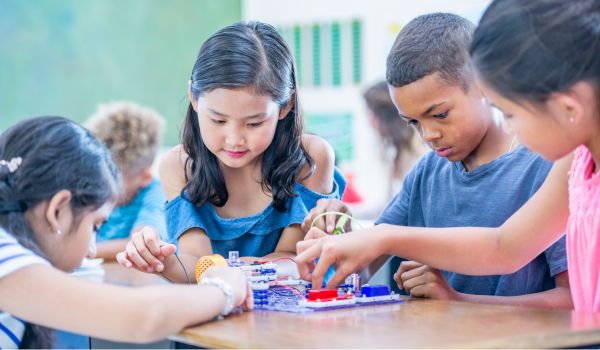
What Types of Basisscholen Can You Choose From?
Choosing a basisschool close to their house is generally the first priority for parents in the Netherlands. There are different types of primary schools across all cities. Schools often give priority to a child with an older sibling already studying there.
You can choose a primary school for your child based on the following categories:
- Public schools: These schools are open to all children, and the teaching is not focused on any religious beliefs.
- Private schools: Teaching in private schools revolves around specific religious or other beliefs. The types of religious schools are Christian, Hindu, Islamic, and Jewish. These schools can refuse admission to children whose beliefs differ from those of the school board.
- Community schools: Community schools focus on child development by engaging children in sport, music, culture, homework coaching, and welfare services, in addition to their regular curriculum. They also arrange parenting and civic integration classes. The types of activities offered by these schools depend on the community’s needs.
- Non-denominational private schools: These schools follow an educational approach which is independent from any specific religion or beliefs. Some examples of these approaches are Montessori, Jenaplan, Dalton, Freinet, and Steiner schools.
- Internationally Oriented Primary Education (IGBO) schools: These schools offer teaching in English but are affiliated with Dutch primary schools.
- Dutch primary schools: They are ideal for children of expats who work and live in the Netherlands for an extended period, for children who have attended school abroad, and for children who are temporarily staying in the Netherlands. The government funds schools and students who follow the IGBO program.
- Schools for special education: These schools serve children who need specialised instruction or extra support. Special education schools are ideal for children with chronic illnesses, disabilities, or behavioural issues. These schools teach the same subjects as the regular primary schools.
Scholen op de Kaart allows you to find and compare the best schools in your neighbourhood.
International Schools
International schools use English as their main teaching language. They are ideal for expat children and non-Dutch speakers. Most international schools follow the British Curriculum, American Curriculum, International Baccalaureate Curriculum (IB), or International Primary Curriculum (IPC). There are some international schools that serve other nationalities, such as Japanese, French, or German.
Your child needs to qualify for admission to an international school based on these regulations:
- The child is born into a non-Dutch family and is not planning to stay in the Netherlands permanently.
- The child belongs to Dutch parents who are supposed to live abroad for at least two years and will be leaving within two years.
- The child has a Dutch nationality but has attended school abroad for at least two years and plans to continue international education in the Netherlands.
Some popular international schools in the country include the British School in the Netherlands, the Amsterdam International Community School, Amity International School, and the American School of the Hague.
While most international schools are private, some are partially funded by the Dutch government. Government-subsidized schools have much lower annual fees than private ones.
Bilingual Schools
Bilingual schools offer lessons and communication in both Dutch and English. They are also known as TTO (tweetalig onderwijs) schools. They integrate international culture into the local curriculum, with around 50% of the focus on both languages.
Some popular bilingual schools are Winford Bilingual Primary School, HSV International Primary School, Harbour International Primary School, and DENISE.
You can find a list of all bilingual schools in the Netherlands here.
Immersion Schools
If your child is 6 years old or older when you arrive in the Netherlands, they must participate in a Dutch immersion program. This helps them get acquainted with the local language. This is called the newcomers class (nieuwkomersklas), which the child can attend for about a year.
There are plenty of immersion schools in the country. They follow the regular Dutch curriculum to help children become fluent in the language. Many international and bilingual schools offer immersion classes.
Special Needs Education
If you have a child with special needs, you must discuss this beforehand with the school you’re planning to enrol your child in. The school then investigates whether your child needs extra care, after which they can refer them to a special needs school.
There are two types of schools dedicated to children who need special care. Special schools for primary education or speciaal basisonderwijs (SBO) offer the same curriculum as regular primary schools. But they have smaller class sizes, so that each child gets extra attention and care. Schools for special education or speciaal onderwijs (SO) cater to children with disabilities or chronic illnesses. These schools are called cluster schools and are divided into four categories, depending on the child’s disability.
- Cluster 1 schools cater to blind or visually impaired children.
- Cluster 2 schools cater to children with hearing or communication impairments.
- Cluster 3 schools are for children with chronic illnesses and physical or cognitive disabilities, which make attending school difficult.
- Cluster 4 schools focus on children with mental or behavioral issues such as autism, ADHD, or ODD.
The Lighthouse Special Education school is the only international school in the Netherlands that offers assistance to children with special needs in English.
The special needs school records your child’s progress. If they show improvement, the child can be transferred to a mainstream school after a few years.
How Basisschool Registration Works in the Netherlands
The process of registering a child at a primary school differs from one municipality to another. You can register your child in your choice of school once they turn three. Many schools, especially in busy districts, have a long waiting period. If you live in such a district, it is advisable to register your child as early as possible.
Many municipalities follow this standard registration process:
- The municipality sends you a letter and an application form around the date of your child’s third birthday.
- You are asked to choose six to eight schools of your preference. In cities like Amsterdam, you must enter at least five schools on the form.
- You must submit this form to the topmost preferred school after verifying all the details, such as your child’s name, address, and date of birth. You must also specify whether they have a sibling studying at the school.
- The school verifies your application form through the central registration system. You will receive a letter within a week to confirm whether your child has been registered.
- The school allocates places to the registered children. If the placement is already full, the school applies a priority system based on distance and siblings attending the school. Otherwise, your child is placed in the next school of your choice.
- You will then receive a letter from the school stating your child has been placed, and you must register them at the school.
- The letter explains the process and the deadline.
- You must carry your child’s BSN, identification proof, and address proof for registration. After the process is complete, your child is officially registered at the school.

What Does a Basisschool Cost in the Netherlands?
Different schools have different fee structures. It depends on the type of education and government support. The costs for a local Dutch primary school are free, as the government funds them. Some Dutch schools may charge a voluntary activity fee, ranging from around €250 to €2,000 per year. Parents are also required to pay for out-of-school care and lunchtime supervision.
Private international schools without any government subsidy cost around €18,000- €30,000 per child per year. The costs of government-funded international schools range from €4,500 to €9,000 per child per year.
These fees do not include costs for registration, application, and enrolment, or for learning materials and school trips.
We hope this article answers all your doubts about finding a good primary school for your child. Make sure to get your child/children admitted to your preferred school if they’re of the appropriate age.