
10 Traditional Dutch Dress Items You Should Know
Categories: Culture,Latest News
When you think of the Netherlands, a few vivid scenes probably pop into your head: windmills, colorful tulips, and wooden Dutch clogs, perhaps. The main streets of many towns are filled with people in their traditional clothing for special events, and they display their ancestral clothing during historic celebrations. The Dutch population maintains strong connections to their traditional klederdracht, which often indicates an individual’s geographical background, faith, and social class. We present the ten most popular traditional Dutch dress styles.
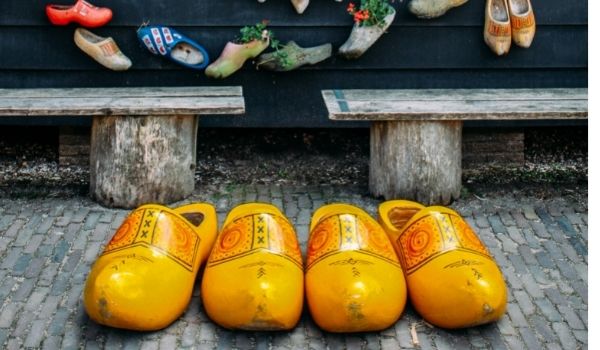
1. Klompen (Dutch Clogs)
We simply cannot ignore the world-famous Dutch clogs (Klompen). Several hundred years ago, leather shoes were very costly but gave very little protection against wet fields. Farmers and workers made shoes from willow or poplar. They were waterproof, safe and very comfortable when stuffed with straw. You won’t see people from Amsterdam coming to their work in these shoes, even though many farmers and gardeners from rural areas use them daily.
2. Lace Caps
The white lace cap is certainly the most recognizable accessory to the traditional Dutch woman’s outfits. The caps were worn initially for cleanliness and modesty and covered all the hair. Over time, they evolved into stunning, complex pieces of lace art. The look and fashion could vary drastically from one town to another. One kind could be pinned to the head so tightly that it was as good as flat, while another style of cap could have frills.
3. The Costume of Volendam
Many postcards featured illustrations of women in typical Dutch attire. This was likely the Volendam costume and has become the unofficial dress for anyone not a native of the Netherlands. With a lace cap and winged edges, this is a distinctive regional dress from the fishing town of Volendam, featuring a striped skirt and a black apron to complete the outfit.
4. Oorijzer
Don’t let the weird name fool you – the oorijzer’s origin is a simple metal wire firmly holding lace caps to girls’ heads. As the economy prospered in the Netherlands, women wore more expensive jewels made of silver and gold to display their wealth, including the oorijzer. Many ear irons in these regions, such as those in Zeeland and Friesland, evolved into decorative jewelry with golden spirals pinned near the surface.
5. The Klalaplços
The “kraplap” is a rather rigid, square piece of cloth worn over the chest and back. The wearer typically uses a pin on the shoulders. The kraplap can really be the centerpiece of a lady’s dress. Depending on the village’s design. Kraplaps would be adorned with colorful floral stitchery or specific weave patterns. On Sundays, you could wear your brightest kraplap, but during mourning, you would switch to dark blue or black.
Read Also: 8 Dutch Gift Ideas: Bring a Piece of the Netherlands Home
6. Wide Men’s Trousers
Dutch fishermen needed wide, loose-fitting trousers to move about in. For Dutchmen, these were usually blue or black, crafted from woollen cloth. Such trousers were particularly spacious at the hips, gradually tapering towards the ankles so that dragging huge nets would not restrict their movement—a fine example of (practical) Traditional Dutch dress.
7. Coral Blood Necklaces
Jewelry in traditional Dutch dress served as a bank account you could wear. In the Coastal communities, red coral necklaces were very popular among women. The thick red necklaces, composed of multiple strands, were secured with large, complex golden clasps. The family’s wealth increased with the size of their coral beads and the weight of their gold clasp.
8. Stipwerk (Dotting) of Staphorst
In the village of Staphorst, the local population developed a way of decorating their clothing called stipwerk. Using wooden stamps and pins dabbed with paint, women would create bright, colourful dotted floral patterns on dark fabric. This art is still practised today and lends a distinct, colorful character to Staphorst’s regional dress.
9. Silver buttons and buckles
Men may not have had lace caps, but they always found ways to display their wealth. A traditional outfit for a man meant wearing large, stylish silver buttons down the front of their jacket or shirt. His belt and buckle, as well as his thigh buckle, all featured large designs depicting biblical themes and scenes, as well as images of ships and farm animals.
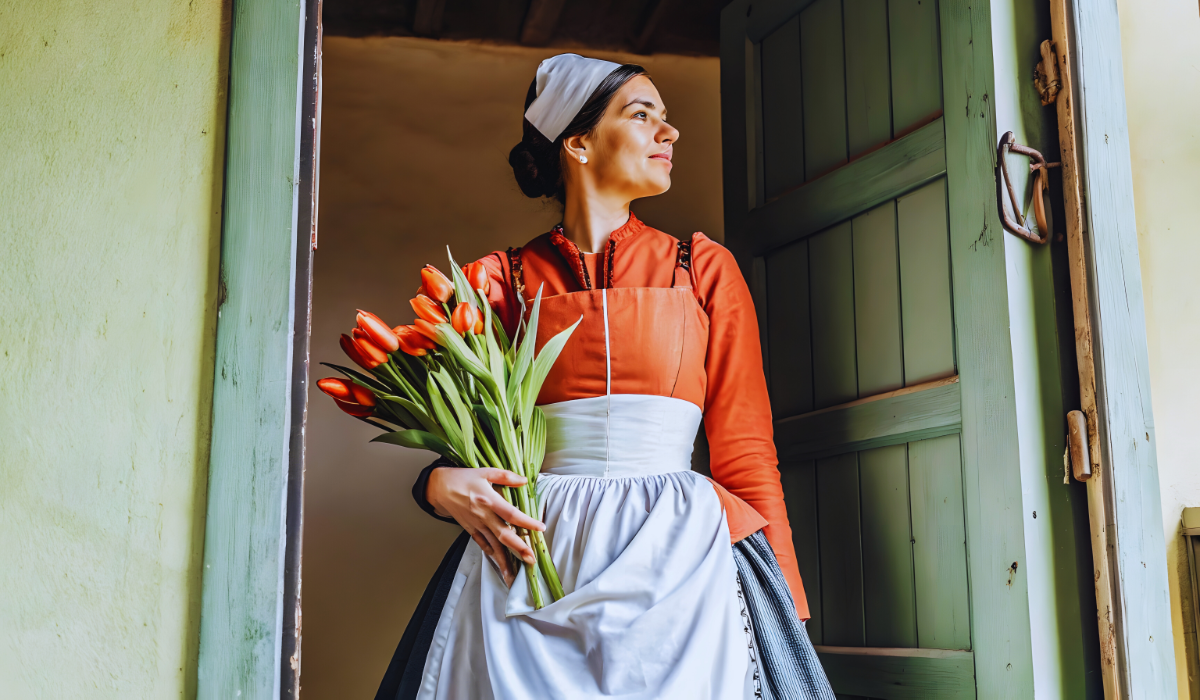
10. The Everyday Apron
An apron was a must for any traditional Dutch lady. These aprons were usually made from easy-to-wash cotton or linen. For church or special occasions, women preferred very elaborate aprons with many pleats, made of long silk or fine wool.
Traditional Dutch dress styles, such as Dutch clogs, are sadly hardly seen nowadays. It doesn’t mean they’ve all been forgotten, either. They are still a common sight on national holidays such as King’s Day, history markets, and folklore days celebrated in towns such as Spakenburg, Marken, and Volendam.
Modern Dutch fashion is inspired by Traditional Dutch dress (klederdracht). Modern designers often incorporate iconic blue-and-white designs, traditional-looking sustainable fabrics, and bulky boots into their collections. Dutch costumes aren’t just trendy clothes. They represent a collective history the country can be proud of.