
Settlement Agreement in the Netherlands: Your Essential Guide (2025)
Categories: career & jobs,Latest News,Legal,News from the Netherlands
Whether you are facing a company reorganisation or have a conflict with your employer, knowing your rights when negotiating a settlement agreement in the Netherlands can make the difference between a smooth exit with benefits or leaving with nothing extra.

What is a Settlement Agreement?
The starting point is that your employer cannot terminate your employment agreement unilaterally. An employer must first obtain permission from the court or the UWV (the route depends on the ground(s) for dismissal). These procedures are often costly, time-consuming, and carry certain risks. For that reason, employers prefer to reach a settlement agreement with employees. For employees, this may imply more favorable (financial) terms and a negotiated, amicable exit.
A settlement agreement (in Dutch: vaststellingsovereenkomst, often abbreviated as VSO) is a mutual termination of your employment contract. Instead of going through the UWV (the Dutch Employee Insurance Agency or the court, your employer offers you a package to end your employment mutually.
This package may include:
- Additional severance pay beyond the legal minimum
- Payment of unused holiday days, bonuses, or share options
- Payment of your legal costs
- Extended notice periods end/or garden leave
- Waiving of non-compete clauses
The above points are commonly included in a settlement agreement. It goes without saying that the stronger your negotiating position, the better the terms you can achieve. We can provide you with clear advice on your legal position and the feasibility of certain conditions.
Did you know? In the Netherlands, employers sometimes offer a settlement agreement without having built any dismissal file. In such cases, employees usually have a very strong starting position in negotiations, as Dutch case law does not accept termination without a proper legal basis or supporting documentation. For employers, it is therefore essential to prepare the case thoroughly.

When Does it Make Sense to Sign a Settlement Agreement?
Whether an employee should accept a settlement agreement depends on several factors:
- Willingness to leave – how strongly the employee wishes to end the employment and start a new chapter.
- Strength of the employer’s legal case – whether the employer has a valid and well-founded ground for dismissal, which greatly influences the negotiation position of both parties.
- Legal and practical consequences of voluntary departure – for example, the impact on unemployment benefits, visa or residence permits, the 30% tax ruling, whether a ban on giving notice applies (such as during sickness) and position on the labour market.
What are the essentials to know before you sign?
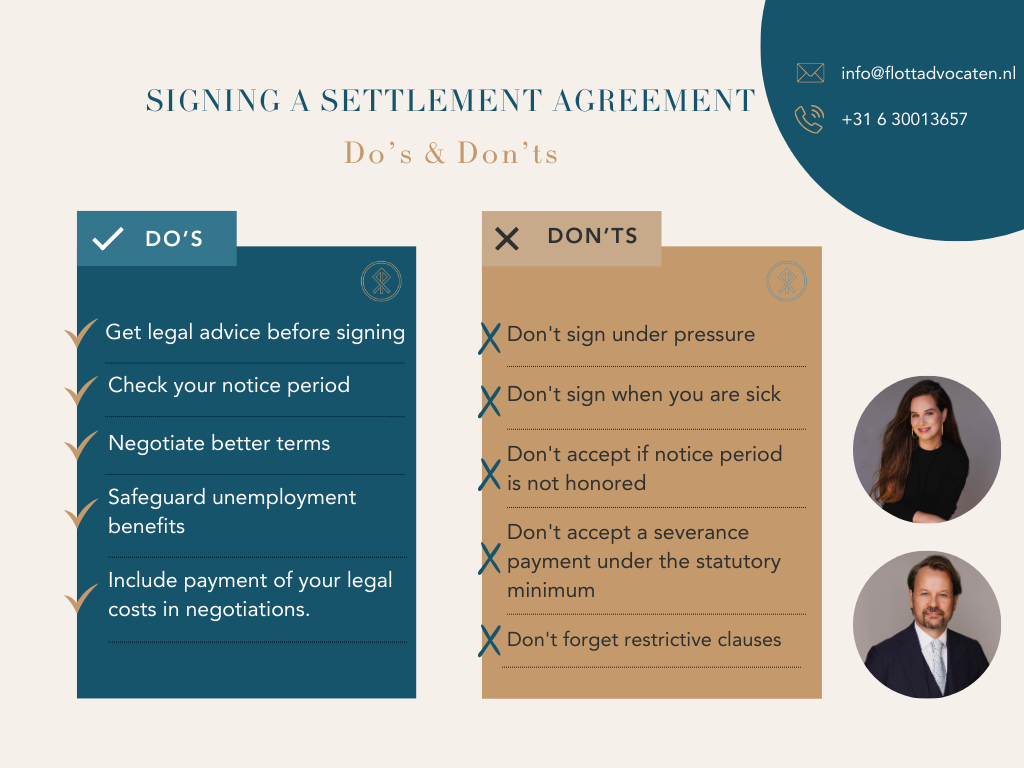
- You cannot be forced to sign. It is your decision.
- Get legal advice: In light of the serious consequences of a termination via a settlement agreement, it is very important to obtain advice regarding your legal position. Many employers cover these costs, which is why it is common to include legal fees as part of the settlement negotiations.
- Impact for internationals: Job loss may affect your residence permit and/or 30% ruling. Let that be checked before signing a settlement agreement.
- Cooling-off period: You have 14 days to withdraw your consent after agreeing to the settlement agreement.

Why Legal Advice Matters
A settlement agreement is a binding legal contract. Once signed, you are committed to all terms – financial, contractual, and post-employment. A settlement agreement may also affect your entitlement to unemployment benefits, which is relevant if you have not secured another job or source of income on time.
As experienced employment lawyers, we can:
- Check whether the offer meets or exceeds legal entitlements
- Assess your legal position and advise you on your rights
- Negotiate better severance terms
- Protect your rights (for instance: regarding bonuses, pensions, and share options)
- Check whether the settlement agreement safeguards your entitlement to statutory benefits (such as sickness or unemployment benefits)
We always ensure that the benefits of the settlement agreement clearly outweigh the costs.
Read Also: 25 Key Questions About Dutch Employment Law Answered (For Expats and Employers)
About Us – Experienced Employment Lawyers
We are Ronald Beltzer and Charlotte Waterman, employment lawyers and experienced negotiators specialising in settlement agreements (vaststellingsovereenkomsten).
We are also the authors of the handbook “De vaststellingsovereenkomst” — a comprehensive guide for HR professionals and employees on ending employment contracts in the Netherlands.
With our deep legal expertise and proven track record, we ensure your settlement agreement is fair, legally sound, and in your best interest.
Need advice on your settlement agreement in the Netherlands?
Contact Flott Advocaten for expert, tailored guidance before you sign.
e-mail: info@flottadvocaten.nl
Telephone: +31 6 30013657