
Top 10 Most Overlooked Amsterdam Historic Buildings
Categories: Culture,Latest News
We all know the Royal Palace, Rijksmuseum, and Anne Frank House. They draw millions of tourists each year and are on every visitor’s bucket list. But for those of us who live here, the truly magical parts of the city are encapsulated in the buildings we cycle by daily. We’re giving you the top 10 Amsterdam historic buildings. However, these are much more than fine-looking facades; they are time capsules of art, trade, religion, and revolution. Here are the top ten hidden spots of history that you’ve been missing in the city.

De Waag Amsterdam (The Weigh House)
Location: Nieuwmarkt
Often dismissed as “that castle restaurant, De Waag Amsterdam might look like a small castle, but it was built in 1488 as a gatehouse, protecting the city from invaders. It was turned into a “Waag” (weigh house). Ships would unload anchors, cannons, and sacks of grain here to be taxed.
Far from just taxes, in 1691, the Surgeons’ Guild built an Anatomical Theater at De Waag Amsterdam, where human bodies were dissected, and some significant innovations in modern medicine originated from this building. This wasn’t a sterile operating room; it was a theater in the literal sense. Next time you’re having a drink on the terrace at De Waag Amsterdam, remember you’re sitting beneath a former operating theater.

The Scheepvaarthuis (now Grand Hotel Amrâth)
Location: Prins Hendrikkade
As far as Amsterdam historic buildings go, this one is particularly impressive. The building was initially built in 1916 as the headquarters for some shipping companies. These companies were the engines of the colonial empire, sending ships to the East Indies, Africa, and the Americas. They wanted a building that said “global dominance.” And they got it.
The exterior is covered in sculptures that don’t just decorate the building; they tell the story of Dutch maritime dominance. Inside the building, the stained-glass windows depict the world’s hemispheres and the zodiac, signifying that Dutch ships sailed under every star and across every sea. While it’s a hotel now, the lobby is open to the public—walk in and soak up the history.

Ons’ Lieve Heer op Solder (Our Lord in the Attic)
Location: Oudezijds Voorburgwal
From the outside, this building looks like a typical house, nestled in the Red Light district, surrounded by neon lights and tourist shops. However, if you venture inside, you’ll find a full-on Catholic church. In 1578, Catholics could not hold public office or build churches. The compromise? You could pray, as long as nobody saw you. Walking through the museum today is a surreal experience. You start in a typical 17th-century living room, then suddenly emerge into a two-story church bathed in light. It survived because it was hidden, and it remains one of the best-preserved 17th-century interiors. It became a museum in 1888.

Het Schip (The Ship)
Location: Spaarndammerbuurt
Most tourists don’t venture this far West, but they should. It’s where you’ll find Het Schip. Built in 1919, this historic building in Amsterdam is an example of how Dutch politics shifted. At that time, Amsterdam’s working class lived in squalid conditions—damp basements, overcrowding, and rampant disease. The Housing Act of 1901 changed everything, allowing housing corporations to build subsidized housing.
The architecture is unique, unconventional, and …… ship like; bricks are laid vertically, horizontally, and in waves. There are whimsical turrets that serve no function other than beauty. The significance of Het Schip is its ideology. It asserts that architecture and beauty are not privileges of the wealthy but rights of the working class. Critics asked De Klerk why he built it. He reportedly replied, “It is beautiful. Is that not enough?”

De Hollandsche Manege (The Dutch Riding School)
Location: Vondelstraat (near Vondelpark)
In the 19th century, this was the place for the city’s wealthy to see and be seen. The balcony overlooking the arena was a social stage where marriages were plotted, and business deals struck over the sound of hooves. Today, it is a “Living Museum.” It is overlooked because people assume it is a private club. While it is a working riding school, you can buy a ticket to enter, sit in the glorious Victorian foyer for high tea, and watch the horses train in the arena below. The smell of hay and leather, the dust motes dancing in the light of the glass roof, and the echo of the riding master’s commands capture a bygone era of elegance.

The Lloyd Hotel (Now The Hoxton)
Location: Eastern Docklands
Built in 1921 by an Amsterdam shipping company as a migrant hotel, this historic building has seen it all. Thousands of poor Europeans stayed here while awaiting medical clearance to board ships bound for South America. The building was designed to be hygienic and efficient, processing humans like cargo. Later, it was used by Jewish refugees fleeing Nazi Germany. Then, it was a juvenile detention center for decades. In the late 90s, the building was transformed by artists and designers to save it from decay and demolition. who saved it from decay. Today, it is a hotel again, but one that refuses to hide its scars. The renovation preserved the history: you can stay in rooms that were once prison cells or office spaces. It is significant because it tells the story of movement—of people trying to leave, people being held back, and people finding a new home.

Huis met de Hoofden (House with the Heads)
Built in 1622 for the wealthy merchant Nicolaas Sohier, the house became a sanctuary for free thought. In the 17th century, the De Geer family (prominent industrialists) owned it. They were patrons of some of the most radical thinkers of the time. The house served as a nerve center for distributing controversial books and ideas. Today, it houses the Embassy of the Free Mind (Bibliotheca Philosophica Hermetica). It is a library and museum dedicated to free thought, alchemy, mysticism, and philosophy. It is often overlooked.

Oost-Indisch Huis (East India House)
Location: Oude Hoogstraat
Built in 1606, this was the principal office of the first multinational organization in history, the Vereenigde Oostindische Compagnie (VOC)—the Dutch East India Company. It discreetly stands on the Oude Hoogstraat, now a part of the University of Amsterdam. Visit the empty inner court and stand where the fate of nations such as Indonesia, South Africa, and Sri Lanka was decided. It was not only used to house offices but also to store cargo, such as silk, porcelain, and spices. The importance and relevance of this building are infinite. The archives housed here once depicted one of the latest cartographical images of the world. From here, orders were issued that sent thousands of people into slavery, and that very same wealth ended up in the construction of the canal ring. It lies forever in recorded history, yet it doesn’t feel any different from any other university building.
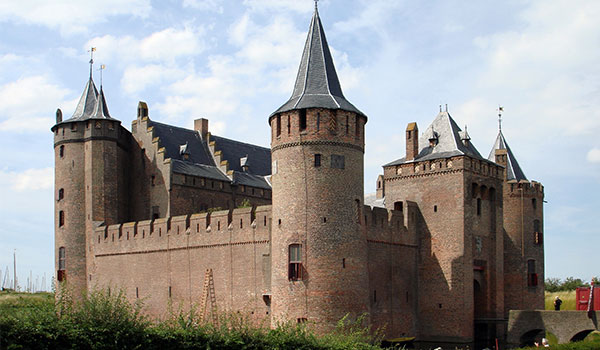
Muiderslot (Muiden Castle)
Location: Muiden (15km from Amsterdam)
If someone were to say to you, “Draw a quintessential medieval castle,” you’d probably draw something that looks a bit like Muiderslot. The Muiderslot has a moat, drawbridge, battlements, and stone towers. It’s incredible to think that the original castle dates to 1285, though it was destroyed and largely rebuilt in its current form around 1370. The castle is often overlooked by expats who think it is a Disney-style attraction for children. But, it’s a great day out for adults too. It’s educational and also fun.

Fort Island Pampus
Location: In the IJmeer (ferry from Muiden or Amsterdam IJburg)
The island’s history dates back to the 19th century, when this sandbank was built over a large sea fort that would, in time, stop the Dutch from flooding their polders. It has a slightly eerie vibe. Now, it is a UNESCO site, a leg of the Historic Defense Line of Amsterdam, and made famous by WWII, when the Germans stripped the island of its metal, leaving it abandoned. Today, it lies there as not only a monument to Dutch hydraulic engineering but also to the futility of static defense. Plus, the boat ride there is half the fun.
The next time you are cycling to work or taking a weekend stroll, try to see the city not as a backdrop, but as a library. These impressive Amsterdam historic buildings, and those outside of it, such as Muiderslot, are just the beginning. Whether it’s understanding the medical revolution above your dinner plate at De Waag or the colonial boardrooms of the Oost-Indisch Huis, the history is there, waiting for you to notice it.