
How Amsterdam Breathes Compared to The Rest of Europe
Categories: Amsterdam Lifestyle,Latest News,News from the Netherlands
If you’re thinking about making Amsterdam your new home, you’ve probably already researched the bike lanes, stroopwafels, and canal views. But air pollution should also be a consideration. Amsterdam is a European capital that has made immense strides toward sustainability while at the same time fighting pollution battles characteristic of a modern metropolis. How is local air quality in Amsterdam considered compared to other world capitals? What policies, challenges, and health considerations characterize the breathing experiences of citizens and expatriates? Let’s take a look at how Amsterdam compares with other European capitals.

Setting the Scene
Air pollution is considered the world’s greatest environmental risk to human health, with statistics suggesting that about 99% of the population lives in areas where air quality exceeds WHO guideline limits.
What is Air Quality?
Before we get into it, let’s talk about what we’re actually measuring. What do we refer to as air quality? How is it determined?
The major air quality indicator is PM2.5, particulate matter with a diameter of 2.5 micrometers or below (μg/m³). PM2.5, minute-sized particles, first enter the lungs and could finally reach the bloodstream; these particles present a complex mixture of soot, sulfates, nitrates, organic chemicals, metals, and dust, mainly emitted from automotive, industrial, power, and domestic scale activities. From a health point of view, these cause harm to human beings. The WHO claims that they are killing millions of people worldwide each year from exposure.
Since these troublesome particles can bypass bodily defenses and travel to the deepest portions of the respiratory system, where they inflict significant harm upon short- and long-term health, PM2.5 has thus remained the chief indicator of harmful air pollution and is universally monitored. Its concentration is the primary metric used to evaluate the acceptability of the air we breathe.

Amsterdam’s Score Card
Generally speaking, the air quality trend in Amsterdam has been good, mainly because of the implementation of environmental policies and sustainable urban planning in the past 20 to 30 years. IQAir, a company active in air quality, produces a yearly World Air Quality Report, listing real-time air pollution data from tens of thousands of monitoring stations worldwide. Amsterdam has placed in the top 5 in Europe for air quality—impressive for a major European capital.
There are, of course, other cities in Europe that enjoy a higher air quality, but at the same time, have a much smaller population. Reykjavik is ranked at number one in Europe, with a PM2.5 (μg/m³) of under five, but with a population of 138,000, it’s easier to achieve a better air quality with a much smaller population. Let’s break down the numbers. Amsterdam clocks in at 10.7 μg/m³ for PM2.5 levels. To give you some context, here’s how it compares to other similar-sized European cities:
- Stockholm leads the pack at 6.2 μg/m³ (goals, honestly)
- Lisbon sits at 9.5 μg/m³
- Brussels and Vienna both hit 10.6 μg/m³
- Amsterdam comes in at 10.7 μg/m³
- Copenhagen follows at 10.8 μg/m³
Sure, Stockholm is showing off with those numbers, but Amsterdam is holding its own pretty well. And if you want to feel really good about these stats, consider that cities like Prague (13.4 μg/m³) and Dublin (13.6 μg/m³) are notably higher, while Bucharest is way up at 21.7 μg/m³.
In a global perspective, Amsterdam’s air quality occupies an advantageous position. European capitals are generally better. The title of the most polluted capital city belongs to New Delhi, which, for the sixth consecutive year, overtook this undesirable distinction with a PM2.5 concentration of 91.8—more than 18 times the WHO annual guideline.
Amsterdam’s reputation as one of Europe’s finest is down to advancements made in the promotion of cycling and renewable energy, alongside the shadow of unresolved issues pertaining to transportation emissions and industrial pollution from nearby polluting industries at Velsen Noord.
Air pollution in Amsterdam comes from a number of sources. In addition to producing a fair degree of PM, soot (BC), and NOx from vehicle exhausts, it accounts for a lot of particulates from road traffic. Diesel vehicles, with their high level of pollutant emissions, are the worst offenders; however, tire and brake wear contribute significantly to pollution. Industry within the city and in nearby regions, such as Velsen Noord, is also not exactly helping.
For the member states of the European Union, policies represent an especially valuable framework for improvement. The Ambient Air Quality Directives set standards for the major pollutants, while the European Green Deal intends to make Europe the first climate-neutral continent by 2050.
The Future of Amsterdam Air Quality
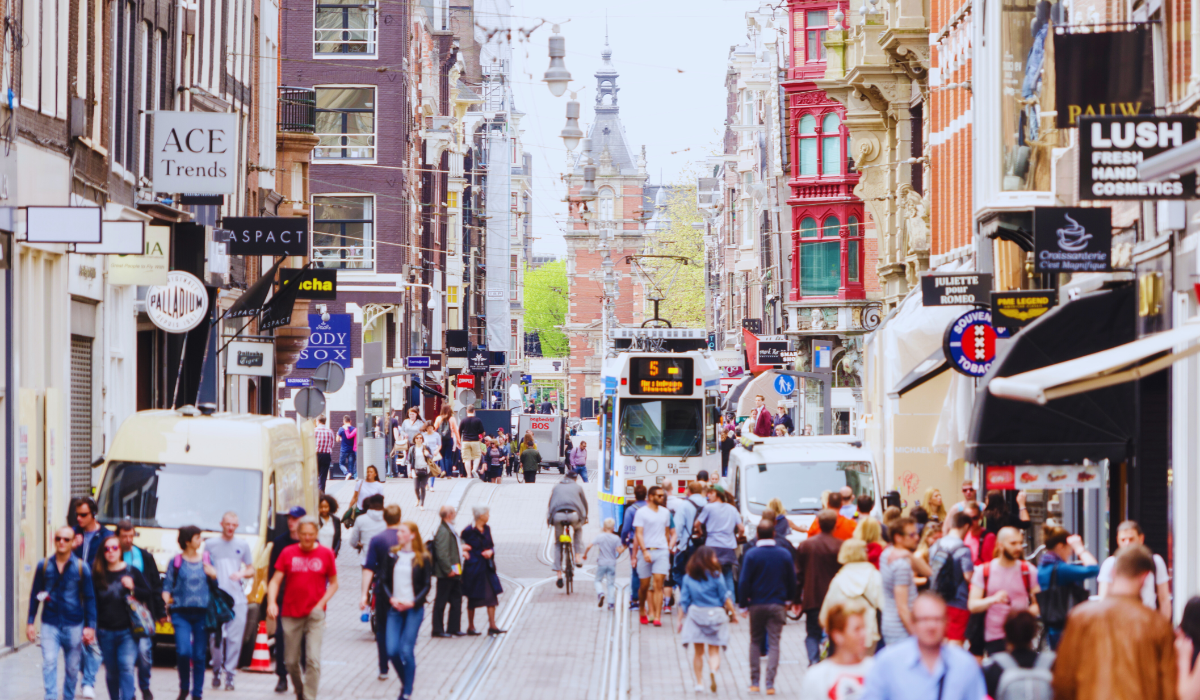
Here’s why Amsterdam does a great job of keeping fresh air in the atmosphere. The bike culture here is not only pretty Instagram-worthy but is really making a difference. Since a considerable number of people choose to roll on two wheels instead of four, this is something that equals cleaner air.
Amsterdam and other world capitals face numerous crosscutting trends that shape their air quality futures. Innovations in renewable energy, energy storage, and transportation are making it easier and cheaper to achieve decarbonization. Recently, Amsterdam has ordered 40 fully electric rubbish trucks for waste-collection purposes, for example. Changes like this will move the needle.
Amsterdam has always been setting big targets, like reaching 75% renewable energy in their energy mix by 2025, targeting a fully circular city with zero waste, and 100% renewable energy by 2050. Achieving these would set Amsterdam among the world’s most sustainable capitals.
However, even with all that, the city continues to sweat over several pressing challenges. Its new national government has threatened to weaken the implementation of climate measures, at least in part, regarding incentives for solar energy and the nitrogen coming from agriculture.
For expats considering Amsterdam as a potential home, the picture looks pretty good from the perspective of air quality, especially when compared with many other global capitals. Is it perfect? Nope. Will you be breathing mountain-fresh air every day? Probably not. But air pollution in Amsterdam is better than most major European cities and significantly cleaner than capitals in many other parts of the world. The city and country’s focus on sustainability movements bodes well for its upward trajectory in the coming years, with the cycling culture, the European Green Deal, and renewable energy transition.